

Language and Culture Week in Fiennes on the Côte d'Opale
from 28 June to 5 July 2025
 The 16 participants (14 from Germany and 2 from Great Britain) in the Language and Culture Week were welcomed in Fiennes with a warm “Bienvenue” by the organising team of the Lille section.
The program included: an intensive week of French, enjoying local culinary specialties, and exploring the cultural treasures of the region... all in a warm and friendly atmosphere.
At the end of the week, all participants unanimously declared: it was an excellently organized event that will remain a fond memory for everyone.
I hope that many friends of Eurojumelages will be inspired by the following article written by the participants and perhaps take part in next year's Language and Culture Week in France.
Sunday, 29.06.2025
After arriving on Saturday at Gîtes Le Tilleul in Fiennes (Hauts-de-France region) and enjoying dinner together, we planned a hike along the shore of the English Channel for Sunday. Following breakfast, our French friends drove us to the coastal town of Ambleteuse on the English Channel. There, at around 9:30 a.m., we started our hike in sunny weather with a little fog in the direction of Cap Gris-Nez. The municipality of Ambleteuse is part of the Regional Nature Park Caps et Marais d'Opale and borders the Estuaires Picards et Mer d'Opale Marine Nature Park on the sea side. The approximately 12 km long hiking trail led north along the ‘Côte d'Opale’ with beautiful viewpoints of the coast and the steep cliffs (‘Falaises’).
times. The crowning glory was the panoramic view from Cap Gris-Nez over the Marais d'Opale nature park, the sea, the English coast and the marine nature park.
A wonderful day with our French friends.
Monday, 30.06.2025
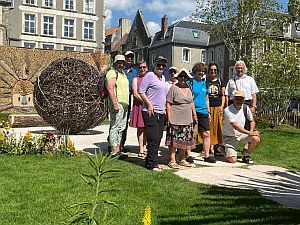 In the morning, we drove in the intense heat to the northern French port city of Boulogne-sur-Mer, a city founded by the Celts that was also of great importance to the Romans. Today, the city is an important centre for fishing and marine industries and France's largest fishing port.
Some of us met in front of the town hall to visit the garden, which is redesigned by the city every two years. In 2025, the garden's motto is ‘Les arts se rencontrent et se répondent’ – Street Art versus Land Art. It is an interesting design that invites visitors to linger.
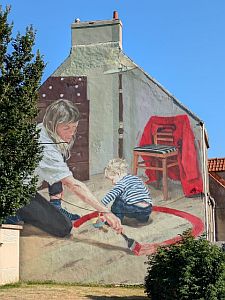
Impressive street art works can be found throughout the city as invigorating elements.
 The three-nave basilica ‘Notre-Dame de l'Immaculée Conception et Saint-Joseph’ (Basilica of Our Lady of the Immaculate Conception) is a Roman Catholic church dating from the 5th century with the largest crypt in France. This crypt consists of a labyrinth of galleries and rooms containing sacred art. Staying in the basilica was very relaxing in the high temperatures.
The city fortifications and gates in Boulogne-sur-Mer were worth seeing, offering a magnificent view of the harbour with the „Nausicaá“ marine aquarium..
Brigitte und Gerhard Klose (Sektion Bonn & Würzburg)
Tuesday, 01.07.2025
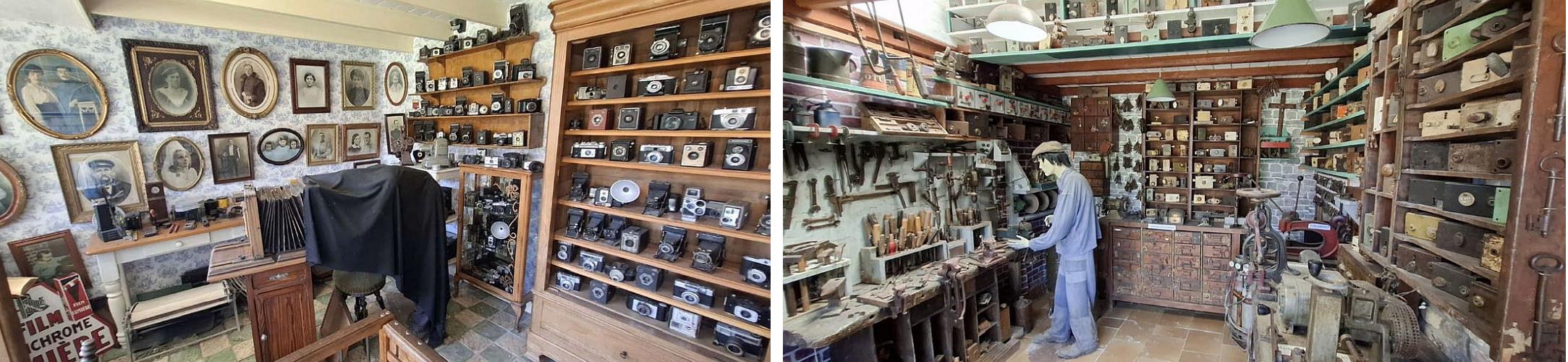
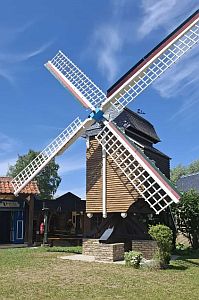 On 1 July, we visited the Saint Joseph Village family museum in Guînes.
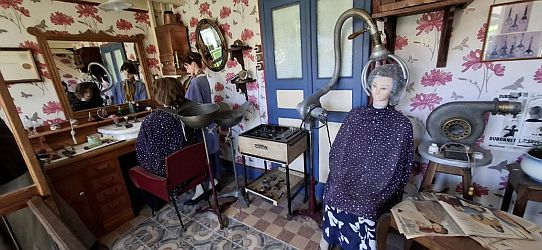
This village has been built up over the past 30 years by cabinetmakers and aims to illustrate the period from 1900 to 1970. Its motto is: ‘Experience the France of your youth!’ Many of the countless objects, and sometimes even their smells, reminded us strongly of the past. We were able to visit the shops, studios and workshops of merchants, farriers, blacksmiths, tailors, hairdressers, carpenters, joiners, wagon makers, locksmiths, saddlers, butchers, basket weavers and shoemakers, with the corresponding tools, materials, products and often the craftsmen themselves (dolls).
There were also halls with tractors, agricultural equipment, cars, bicycles, toys, musical instruments and music equipment. We were also able to see a watermill, a classroom and a church, and try out games of skill and puzzle games. More information can be found at www.st-joseph-village.com.
After having fun in the intense heat, some of the group treated themselves to refreshing local drinks such as Freneytte at a café. We, however, sought out another beach nearby, this time Bleriot-Plage, and enjoyed a lively swim in the English Channel. On the way back, we were impressed by a gigantic supermarket and spent a considerable amount of money. As always, Laurence Lebeau prepared a magnificent dinner, home-cooked, tasty, interesting and à la française with several courses.
Individual preferences were also taken into account. We cannot praise our French friends highly enough for making our stay in Fiennes so personal and heartfelt. This also applied to the language lessons. The two of us were in Group 2, which was coached by Philippe Lebeau and Laurence Trossat. Using funny homonyms, fables, excerpts from the film ‘Camping’ and various chansons, we worked our way lightly through the grammar, internalised lots of vocabulary and then went on to learn argot, youth language and even Sch'ti. Time flew by and soon it was time for Laurence's superb lunch, prepared just in time for us hungry students.
Wednesday, 02.07.2025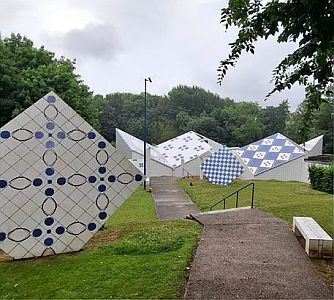 The museum in Desvres, which we visited on 2 July, has an impressive collection of historical and contemporary ceramics.
Visitors can learn more about the techniques, history and significance of ceramics in the region. Various manufacturing methods
are demonstrated here, such as modelling, casting, firing and glazing ceramics. There are also special techniques such as throwing on a potter's wheel and decorating with colours and patterns. The different types of ceramics: Tableware ceramics: These ceramics are made for everyday use, such as crockery, cups, plates and bowls. They are often coated with glaze to ensure water resistance and a beautiful finish..
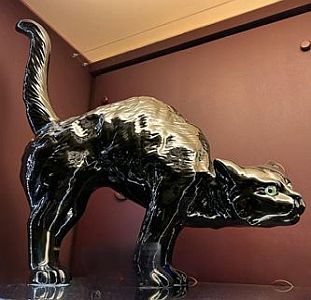 Decorative ceramics: These are artistic pieces that serve primarily as decoration, such as sculptures, vases, wall panels or figurines. They are often artistically painted and glazed. Fired ceramics: This includes all ceramics that are specially manufactured for the firing process, such as tiles, bricks and tiles. They are robust and are often used in construction. Stoneware: A robust, porous ceramic that is fired at medium temperatures.
With or without glaze, it is used for pottery and household items. Porcelain: Very fine, translucent ceramic that is fired at high temperatures. It is hard, smooth and often used for fine tableware and works of art.
Technical ceramics: Manufactured for industrial purposes, e.g. in electronics, medicine or the automotive industry. It has special properties such as heat resistance or electrical insulation. Ceramics consist mainly of natural mineral raw materials that are fired at high temperatures to obtain their characteristic properties.
The most important components are: Clay: The basic material for many ceramics, especially pottery and bricks. Clay consists of fine mineral particles that absorb water and become solid and hard after firing.
Kaolin: A special type of clay, also known as porcelain clay, which is very fine and pure. It ensures the transparency and fineness of porcelain.
Feldspar: A mineral component that melts during firing and improves the glaze and strength of the ceramic.
Sand: Often added to increase stability and heat resistance.
Plant or mineral additives: Sometimes other mineral substances or organic materials are also used to achieve certain properties. During firing, these raw materials are fused or solidified together, giving the ceramic its final properties – such as hardness, water resistance and stability. The exact composition varies depending on the type of ceramic and its use.
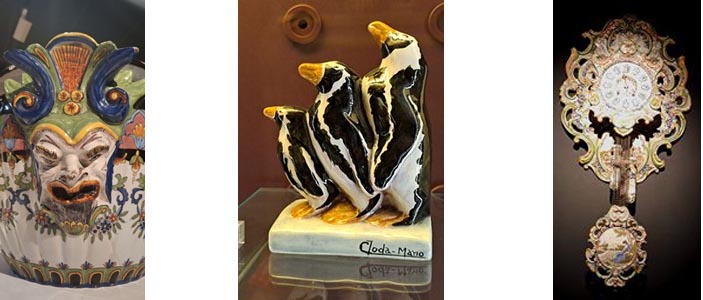
If you're ever in the area, it's worth a visit.
Afterwards, we visited a chocolate factory and bought some delicious chocolate…
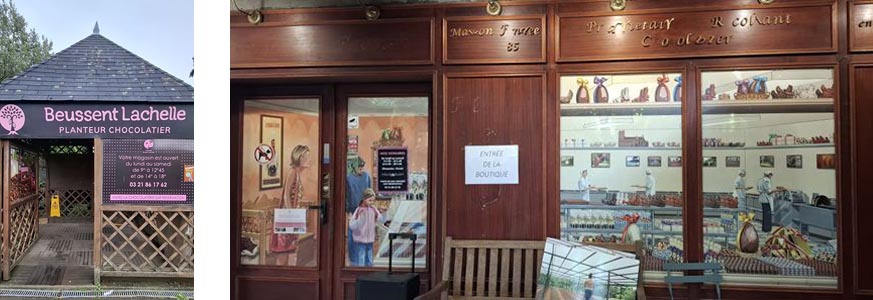
The factory has its own cocoa plantation in Ecuador and produces its chocolate directly from cocoa beans.
Sonja Mechtel und Margita Lentz (Sektion Bonn + Stuttgart)
Thursday, 03.07.2025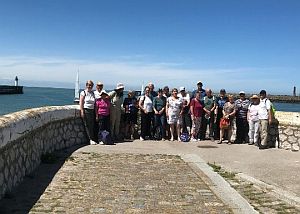 After the morning courses and a hearty lunch, we met in the courtyard for the afternoon tour to Calais. Spread across several cars, we set off at 2.30 p.m. for the port city on the Channel coast, some 20 km away. Numerous ferries operate here to and from England. The shortest connection between Calais and Dover, at just under 50 km, takes about 2 hours. The railway tunnel under the English Channel also begins west of Calais.
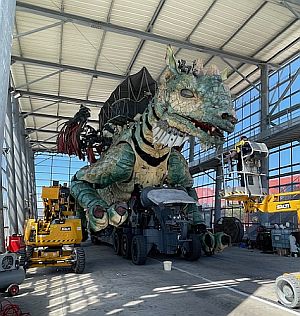 After arriving together next to the harbour, we were able to admire the huge mobile dragon model made of steel and wood (Compagnie du Dragon) in an open hall, which had been decorated for the national holiday on 14 July. Riding on the dragon's back along the beach is a special experience.
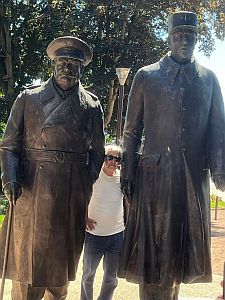
On the way to the city centre, the larger-than-life bronze statues of Winston Churchill and Charles de Gaulle remind us of the allies in World War II.
 The town hall (Hotel de Ville) impresses with a 78-metre-high bell tower that is open to the public. The town hall forecourt, with its beautiful flower beds, is home to the famous bronze statue ‘The Burghers of Calais’ by French artist Rodin. The scene commemorates the siege of the city in the 14th century by the English and the courageous actions of six citizens who saved the city from destruction.
On the way back to the accommodation, a small group wanted to take a detour via the coastal road to Cap Blanc-Nez and the magnificent view of the chalk cliffs, the Channel coast, the port of Calais and the impressive distant view of the English coast with the chalk cliffs of Dover.
After dinner and subsequent conversations well into the bright night, a short sleep had to suffice in order to tackle the next day with concentration.
Friday, 04.07.2025
That afternoon, Wimereux, a small town on the Opal Coast, was on the agenda.
Before lunch, we had the opportunity to meet Joel Huberdeau and his wife Francine, who visited us until early evening..
Our chef Laurence had planned a tour of the town as our guide.
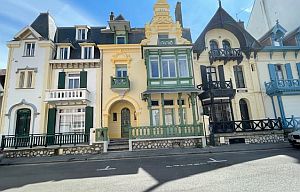
At the end of the 19th century, Wimereux, easily accessible by rail, became the first seaside resort in the area to be visited by wealthy citizens from England, Belgium and France. Some had architecturally attractive town villas built in the Belle Epoque style.
Laurence took us on a tour of 10 Victorian Anglo-Norman villas with elegant façades and gables, some decorated with ceramic frescoes.
On the last evening, a full programme awaited us.
Before the meal, we tried our hand at karaoke, which Philippe had prepared. He presented us with a list of French and English pop
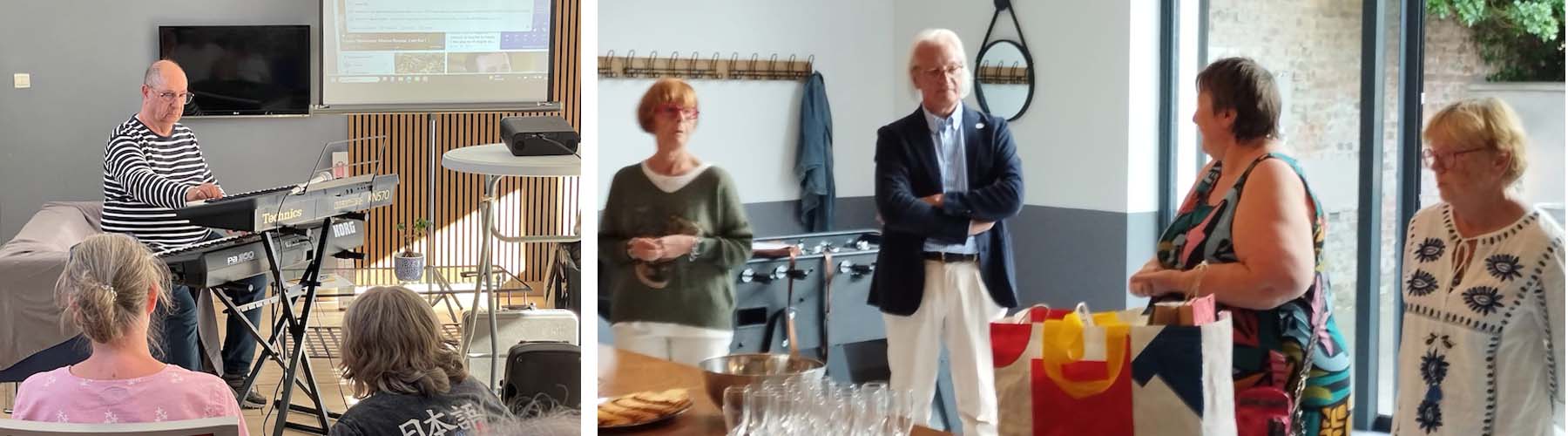
Peter Backes's thank-you speeches to the kitchen team and our four language course teachers were a must, as was our presentation of sweet gifts.
The delicious evening menu, prepared with particular care and attention, was kicked off with a champagne reception.
Hildegard und Georg Natterer (Sektion Stuttgart)
Many thanks to the entire Lille section team for this unique week.
